First published by the National Secular Society.
British-Iranian secularist and human rights activist Maryam Namazie explains why the Iran protests are different this time – and why young Iranians are embracing secularism.

The people of Iran are in open revolt.
Since late December 2025, protests have erupted across the country in 73 cities. They rapidly became an unambiguous rejection of the Islamic state itself. This time, the trigger was a collapsing currency, unpaid wages, soaring food and fuel prices, and widespread shortages—rooted in mismanagement, corruption, and a system that governs through poverty, sex apartheid, and institutionalised violence.
The regime’s response has been immediate and brutal. Live ammunition has been fired into crowds. According to official sources, hundreds have been arrested and charged as mohareb (“enemies of God”), punishable by death. Estimates for those killed are much higher, reaching into the thousands. But with the shutdown of internet access and communications, alongside widespread repression, the true scale is hard to confirm. This is not incidental: it is a common practice by the regime to sever coordination, conceal the scale of killings, and isolate people from one another as it intensifies repression.
Video footage that has made it out reveals systematic massacres. A horrifying video circulating online, reportedly taken on 8 January from outside the Kahrizak Forensic Medicine Centre, shows rows of bodies laid out as families search for missing loved ones—and all the while, more bodies arrive by truck. This is the Islamic Republic governing as it always has: through terror and religious legitimisation of mass murder.
Reports indicate that families have been forced to pay for the bullets used to kill their children before bodies are released, and that they are prevented from organising funerals or mourning, a practice with clear precedents in the era of mass executions in the 1980s. Collective grief is criminalised.
What is currently happening in Iran is not another protest cycle. It is the collapse from below of religious authority as a system of rule.
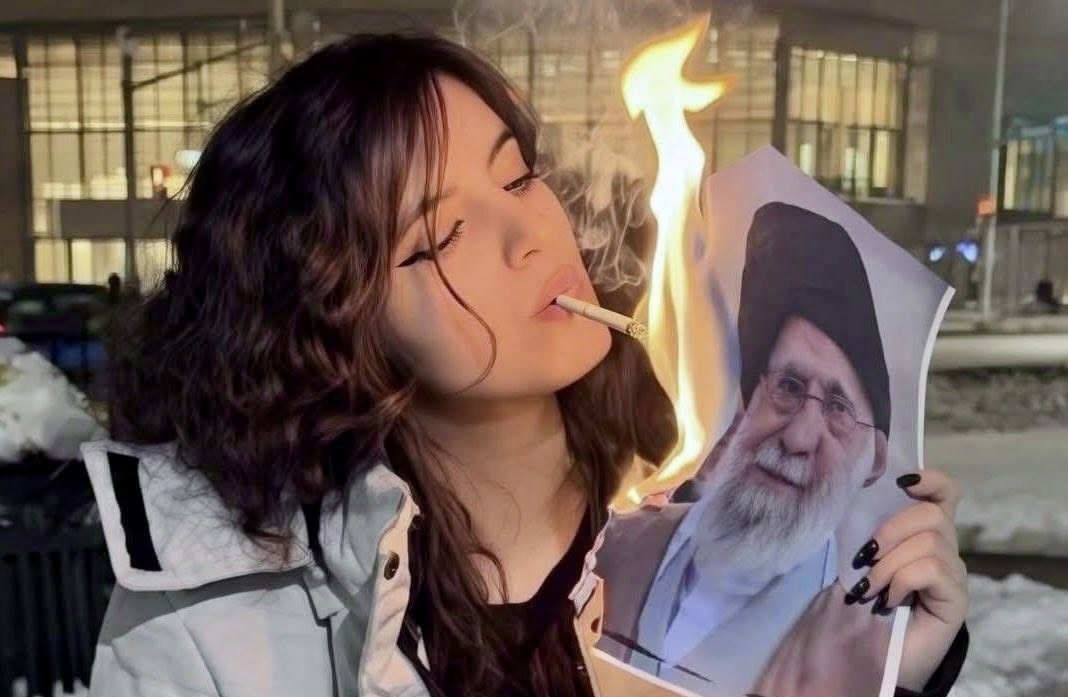
This began in 2022 with the Jin, Jiyan, Azadi (Woman, Life, Freedom) revolution sparked by the murder of Mahsa Jina Amini for ‘improper veiling.’ With over 70% of the population in Iran under 35, generation Z, raised entirely under an Islamic Republic, has broken with theocracy entirely. It does not debate interpretations of Islam. It does not look for progressive clerics or illusory ‘reforms.’ It does not buy into bogus claims of Islamic ‘democracy’ and Islamic ‘feminism.’ It recognises religion as an instrument of domination. Clerics are mocked and chased. Mosques are targeted as organs of state power. Religion no longer commands respect for a large number of people. There is a tsunami of atheism in the country. These are defining characteristics of ‘Woman, Life, Freedom’ and why it targets clericalism and theocracy.
This is secularisation from below. Not legislated. Not negotiated. It exposes the racist deception of cultural relativism that portrays Islamism as people’s culture. The state now governs a population that has already exited religious rule in everyday life. This is why Woman, Life, Freedom endures after widespread repression and why the current protests are a continuation of the unfinished business of finishing the regime.
Women’s oppression is not a parallel injustice alongside economic collapse. Compulsory veiling, sex segregation, patriarchal family law, and sexual policing aim to punish women’s labour, enforce unpaid care and housework, depress wages and manage the economic and political crises. Sex apartheid is also economic policy. This is why attacks on women intensify during economic breakdowns. When the system cannot deliver stability, it governs through the suppression of bodies. And when women revolt, the entire structure is exposed.
Woman, Life, Freedom refuses the separation of feminism from class struggle, secularism from survival, bodily autonomy from material life. That is why the slogan, first raised in Rojava, Syrian Kurdistan, has taken hold of society. It speaks to how people want, and deserve, to live.
The movement’s danger to the status quo is clear. This is why in the current revolt, attempts have been made to contain and rebrand the uprising into a ‘national revolution’ in which the former dictator’s son, Reza Pahlavi, is promoted as the inevitable future leader, distorting people’s demands and turning the revolt into a tool of geopolitical machinations. This is a false choice between turban or crown, aimed as erasing the uprising’s secular and feminist core. This is not only about nostalgia but the dangers of a women-led, anti-clerical revolt. Hence why Rojava is also under constant attack.
A defence of secularism and women’s revolution in Iran is a defence of its content: secularism as a material necessity; full equality for women and LGBT people; freedom of organisation, strikes and political assembly; and abolition of executions, religious courts, and patriarchal law.
Woman, Life, Freedom is not a mere slogan. It is a break with the past. The future of Iran will not be decided by crown or turban. Iran’s future is female, egalitarian and secular. Against clerics and kings, against militarism, and against regime changes from above.
The defiance of women and others oppressed by the regime have already severed the link between religious authority and social life. The state persists only through sheer violence. How long the theocracy can function in open contradiction to everyday life remains to be seen. The Woman, Life, Freedom movement, however, has already marked a break from which there is no return.

Maryam Namazie
Maryam Namazie is an Iranian-born campaigner and spokesperson for One Law for All and the Council of Ex-Muslims of Britain. Twitter: @MaryamNamazie. The views expressed in our blogs are those of the author and may not necessarily represent the views of the NSS.
Leave a Reply