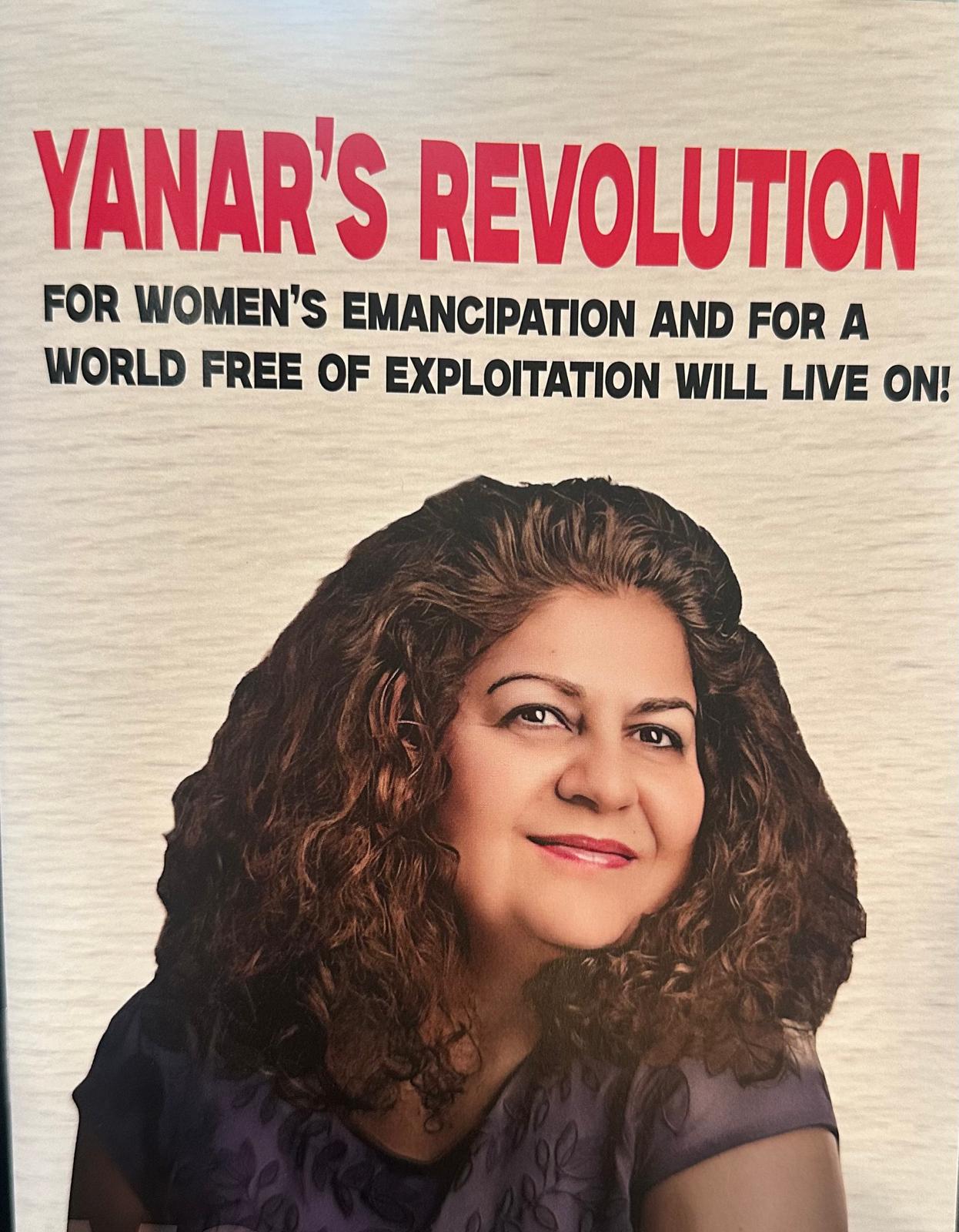
On 1 March 2026, the day before she was killed, Yanar Mohammed called for accountability for sex trafficking and for ISIS crimes against women at a conference in Baghdad.
The next morning, on 2 March, she was assassinated at her home.
Part of her human-centred politics was a rejection of the false choice between external bombing and war and internal Islamism and authoritarianism. A false binary of ‘choice’ that aims to remove people’s capacity to determine their own future.
Whether war, authoritarianism or Islamism, power always reliably relocates onto controlling women and is formalised into law, family structures, and the public space. The Personal Status Laws in Iraq, Iran and Afghanistan or compulsory veiling are not trivial. They are declarations of how authority will be organised through the regulation of women’s bodies, for the control of social reproduction itself.
Yanar Mohammed knew this and did not treat women’s oppression as one issue among many. Control over women’s bodies is not one mechanism of control. It is the mechanism through which power is made durable and stabilised and reproduced.
She understood that any movement that postpones women’s liberation is not delaying it but preserving the structures it claims to oppose.
Yanar Mohammed built shelters, networks, a generation of activists, and a body of thought as politics itself, not alongside it.
For decades, she built structures that made it possible for women to live outside systems of violence in conditions where the state and its institutions refused protection.
She stood against all forms of power that depend on women’s oppression under occupation, under Islamism, under constant threat and risk in Baghdad.
The people of Iran are now presented with a familiar false ‘choice’ – external bombing or internal repression.
This is not a real choice but a political construction that removes society, workers, students, ethnic and sexual minorities and women as a third force, which Yanar represented.
Bombs do not dismantle oppression. They rearrange it under new conditions. Internal authoritarianism maintains itself most visibly and fundamentally through the control of women as a means of controlling society.
Both depend on the same condition: the removal of social and political forces as actors. The state claims there is no alternative to its rule. Trump and Netanyahu claim change cannot happen without them.
Yanar Mohammed’s life and struggle, like Woman, Life, Freedom, rooted in Kurdish struggle, show a third way. It identifies where power is reproduced daily, through the control of women’s bodies as a means of organising society.
Women are central because the system depends on their regulation. Therefore, women’s liberation is a condition of the liberation of our societies.
The beloved communist and feminist Yanar Mohammed was assassinated because this is the site of struggle at which oppressive systems are most exposed.
What she built was material, deliberate and revolutionary. It is what a better world is built on.
We commemorate her life and her struggle.
We and the world have lost a fierce and beloved comrade. The world was better with her in it; it is poorer now without her.
But her struggle continues.
Long live Yanar Mohammed!
The above was Maryam Namazie’s speech at a commemoration event in London on 29 March organised by Organisation of Women’s Freedom in Iraq and Organisation of the Communist Alternative in Iraq.
Leave a Reply