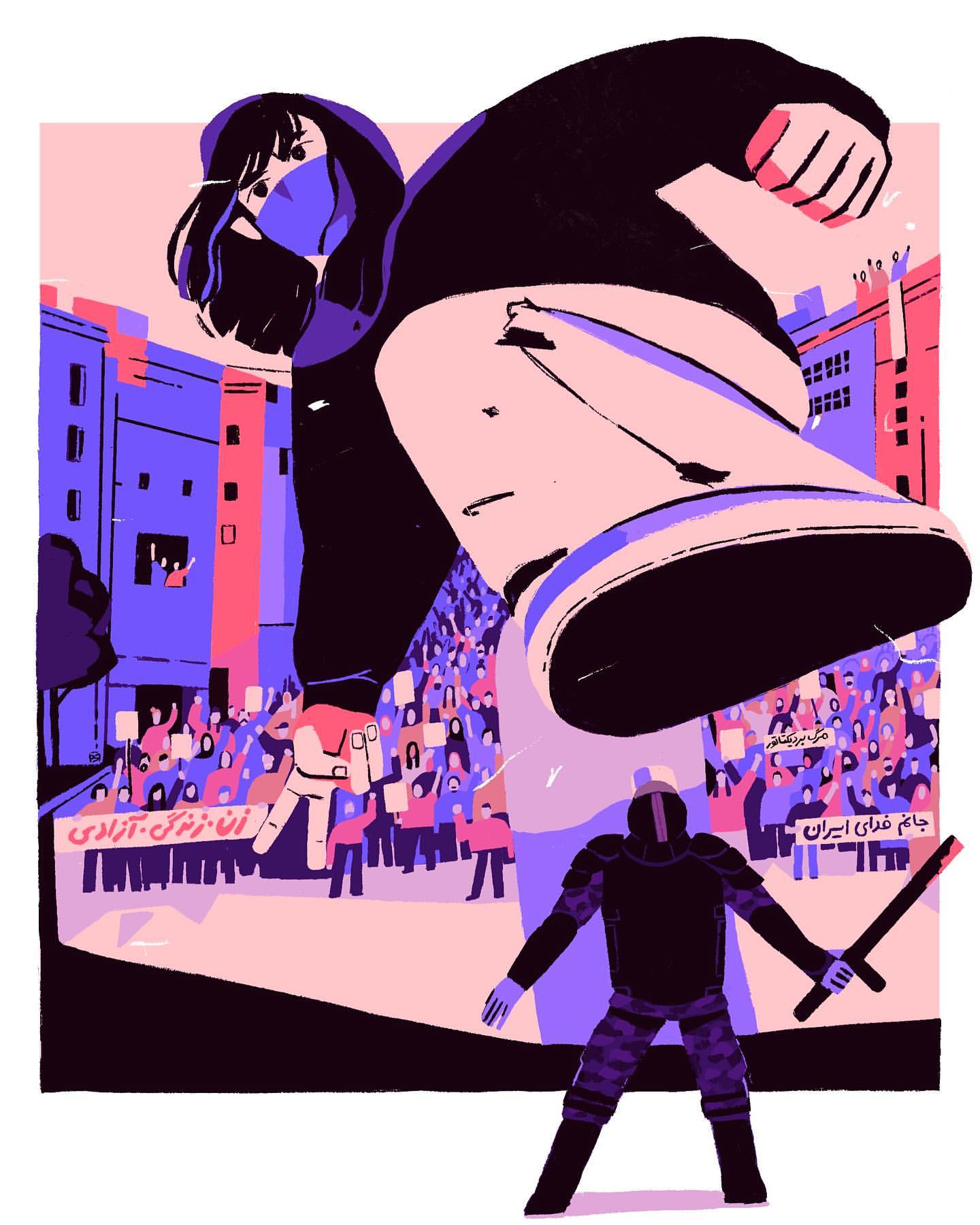
This is an edited transcript of Rod Liddle’s interview with Maryam Namazie on Iran protests, Times Radio, 17 January 2026
Persian Translation: مصاحبه با رادیو تایمز: پس از ۱۰۰ سال دیکتاتوری، مردم ایران حق دارند سرنوشت خود را تعیین کنند
Rod Liddle: The uprising or revolution whatever you want to call it in Iran seems to be at something of a crossroads. The Iranian regime has not it as it suggested executed any of the protesters it has arrested, nor has there been a continuation of the violent repression which has seen as many as 12,000 people killed in the totalitarian Islamic republic. But the protests seem to have subsided too, and one begins to wonder if what the West was heralding as the final toppling of the brutal clerical rule in Iran may simply have been another outpouring of anger quickly stilled from the benighted people of that country.
Maryam Namazie is an Iranian dissident who has lived in London for many years, a Marxist, she was a member of the Iranian Worker-Communist Party and she has seen many uprisings before, subjected to a fatwa by the mullahs, she has also faced threats from the Iranian regime. I asked her if the uprising was now dwindling a little.
Maryam Namazie: There is a generation now in Iran that will not tolerate an Islamic theocracy. They don’t buy into Islamic reform, Islamic feminism, Islamic democracy. They don’t accept a reformist so-called faction of the Islamic regime of Iran; they don’t want a theocracy. It’s a movement and protest that needs to be supported across the globe, not of course by regime change from above. It’s a very important movement. My heart goes out and my condolences goes out to all those who’ve lost family members and loved ones. There have been huge amounts of killings. People are talking about massacres that have taken place. The numbers are unclear. There are reports of over 12,000 people being killed.
Over here, this has been portrayed as a revolution which has been provoked largely not by the ideological objection to an Islamic theocracy but through economic necessity as the economy has crashed and people are broke. My point is, however, that the economic catastrophe is part and parcel of a catastrophe and crisis when it comes to personal and civil liberties as well. Every aspect of people’s lives is in crisis because of this regime – either it’s mismanagement, its corruption or its all-out repression; the fact that a theocracy is antithetical to the lives of 21st century human beings.
You can’t foresee when this regime is going to end but that break has been made and there is no turning back from where the people of Iran are today. They don’t want a theocracy.
Rod Liddle: There are these appalling things happening. 12,000 dead, you say, a violent authoritarian crackdown on the protests and the threats of hangings, the threats of shootings and so on. And yet you say this must be a revolution which happens from within. Were it not for Donald Trump’s insistence that unless the Iranian revolutionary guard and the government stopped these massacres and ceased any threat to hang protesters then there would be an immediate response from America. That is outside help and it works, doesn’t it?
Maryam Namazie: That is a lot of posturing really to be frank because if you look at a report from a human rights organisation that covers executions in Iran, from the period of January 5-14th, 52 prisoners were executed in 42 prisons. So, the regime has continued their executions and they will continue their executions because this is a regime that has done this for the past 47 years. The political posturing and geopolitical manipulations in various self-interests of governments doesn’t really address the huge catastrophe and tragedy that is taking place for the people of Iran; it doesn’t address human rights.
Rod Liddle: Hang on Maryam, just to pick up one point there. It was said that that one particular Iranian protester, the owner of a clothes shop in Iran was going to be hanged yesterday. Trump intervened and he wasn’t hanged. That’s surely beneficial, isn’t it? That you can’t argue against that, can you?
Maryam Namazie: Erfan Sultani is the person you are referring to. Let’s be clear, there are thousands waiting to be executed. The regime itself has said they have arrested thousands that will be executed as enemies against God. The executions will happen. We’ve had many examples, of course, where public pressure has stopped an execution. Give credit also to a vast diaspora as well as people in Iran and the mass protests of organisations and individuals demanding an end to executions. We can’t give credit only to Donald Trump for this.
Rod Liddle: I wasn’t suggesting you give credit only to Donald Trump. You talk about all these executions and the murder of so many people. Doesn’t that beg for outside interference to stop that murder?
Maryam Namazie: It does. Of course, you’re right. It does beg for outside interference in the sense that it begs for solidarity and support for the people of Iran in this revolution that is underway. But I think the question is whether US militarism is the solution. If we look at the region, if we look at Afghanistan, if you look at Iraq, if we look at what is happening in Syria for example, this is not the solution. Also, in the Palestinian territories. Militarism is not the solution to bringing peace and prosperity and rights for the people of Iran who deserve a lot more than that. For me, when Donald Trump postures and says he stopped 800 executions, therefore he’s not going to intervene – these are geopolitical posturings. What governments can do is not to impose regime change from above, but to actually stop providing support directly or indirectly to the Islamic regime of Iran. Why are the Islamic regime of Iran’s embassies still open? Why are the assets of the revolutionary guards not being seized? Why are government officials that travel outside not arrested for crimes against humanity? I think there are so many political and diplomatic measures to put this regime under intense pressure that isn’t happening. There’s a lot of sloganeering, a lot of statements and hashtags, but nothing that really helps the people of Iran. And the other issue is the communication and internet blackout. We know that when the regime does this, it is because it is slaughtering people and doesn’t want witnesses. It has imposed martial law. It has issued a statement to say that anybody who is publicising information about what’s happening in Iran will be executed as a spy for Israel and the United States. So opening Starlink, opening up communications, cyber intelligence against the regime… All of these are ways in which pressure could be brought on the regime and people of Iran supported in order to continue their revolutionary movement against a theocracy. I mean this is Handmaid’s Tale in real life.
Rod Liddle: Are the people of Iran, the people who are taking part in these demonstrations, are they fully behind the son of the Shah? And are we being told the truth over here when we’re told that they wish for his return to the country and that he might mediate and provide some sort of government in the future?
Maryam Namazie: In all honesty, monarchists are a political trend in Iran, as are communists, as are secularists, as are Republicans. Iran is a huge country of 90 million people with a vast plurality of backgrounds as well as opinions. It is now portrayed as if “Long Live the King” is the main slogan of people in Iran and the Woman, Life, Freedom revolution has been rebranded as an Iranian national revolution by a diaspora media like Iran International. These are all posturings in order to impose regime change from above and to contain a Woman, Life, Freedom revolution that doesn’t want the same old, same old. We don’t want to move from the Shah’s dictatorship to an Islamic dictatorship to another form of dictatorship. People in Iran deserve better. And I personally wouldn’t accept any diaspora leader. There is a huge movement in Iran, progressive, secular, modern. Evin prison and prisons across Iran are filled with political prisoners, women and men who have been campaigning and organising for decades for people’s civil rights and for an end to this regime. The leadership of Iran, the future of Iran is going to be female. It’s going to be secular. And the leadership of this movement is going to be found in Iran, not abroad and not in some exiled prince who’s living off the money his father stole.
Reza Pahlavi has dreams of reinstating a monarchy, that was oppressive. I’ve even had to go to the police not only about threats that I faced from the Islamic regime of Iran, but threats from his supporters. In the diaspora, the monarchists have beaten up opponents, broken PA systems of others, torn down banners of any opposition that doesn’t support the monarchy. They have threatened to find me and kill me because I don’t agree with the monarchy. Reza Pahlavi is not going to be a change for us. They defend Savak, the old Shah’s secret police and say that it didn’t go far enough. Once of their slogans is “death to Mullahs, Leftists and Mojahedin.” Of course, you can be against any ideology and any system but to call for the death of people is incitement to violence. I don’t agree with the Mojahedin. I wouldn’t even accept any leftist leader from abroad taking over the leadership in Iran, even though I am on the left. Because the future leaders of Iran are in Iran itself, not the diaspora. With all its threats and violence, the monarchist opposition gives us very clear signals of what they intend to do when they return to Iran. Will we even be able to return to Iran if they come to power? That’s a big question for a lot of us in the diaspora that don’t support the monarchy. I think people in Iran have a right to finally – after 100 years of dictatorship – decide their own fate.
Rod Liddle: Well, there you are. That was Maryam Namazie, Iranian dissident who I spoke to late last night. And at this very moment, she’s on a demonstration in Paris.
The above is an edited interview with Times Radio.
Leave a Reply