Iran: On Power, Inheritance, and the Disciplining of Women’s Bodies, The Freethinker, 25 January 2026
Farsi: ایران: دربارهٔ قدرت، حکومت موروثی، و کنترل بدنهای زنان
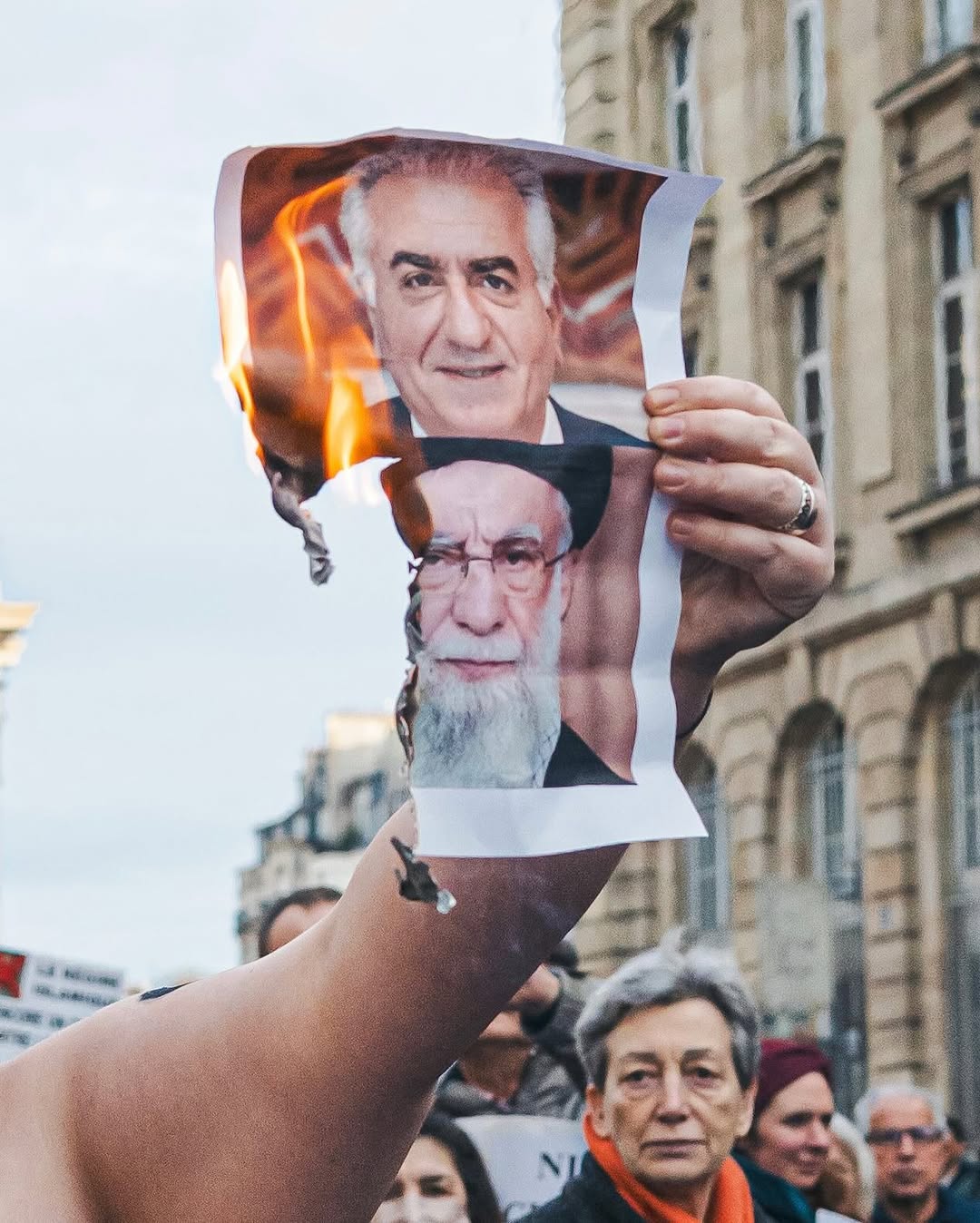
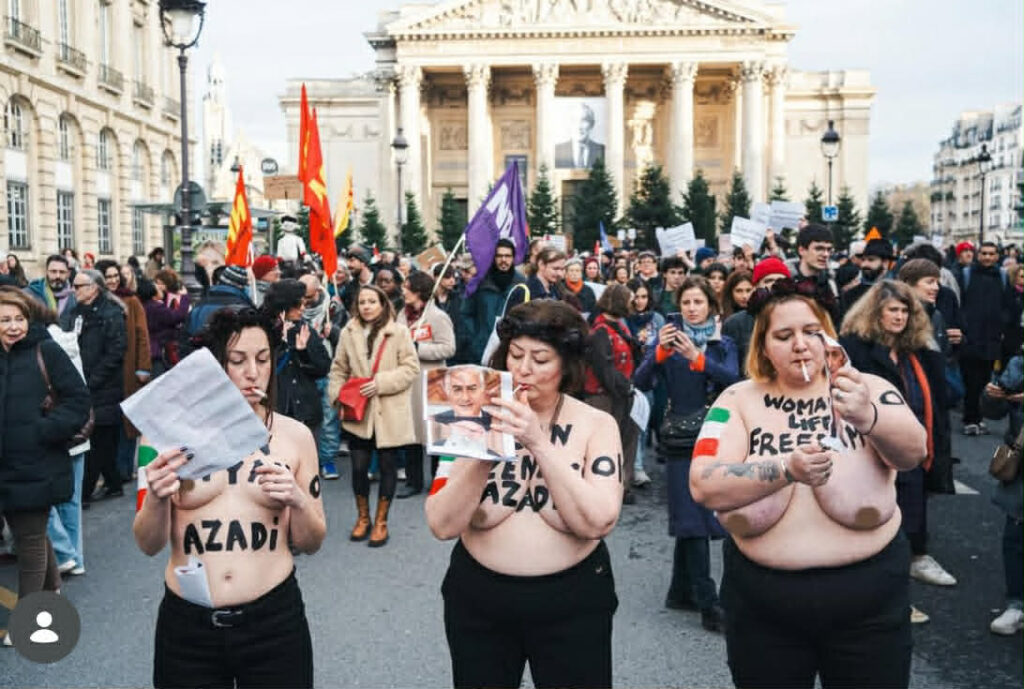
This essay responds to critics of my 12 January 2026 Freethinker article Neither turban nor crown but Woman, Life, Freedom and of the FEMEN topless protest in Paris, during which photos of Ali Khamenei and Reza Pahlavi were set alight.
Its aim is not to defend a slogan or an action, but to expose the political project this refusal disrupts, a project already working to reassemble authority in advance of the Islamic regime’s collapse. What is at stake is whether authoritarianism will continue to be organised through clerical or inherited patriarchal authority or dismantled altogether.
Revolutionary moments are not defeated by repression alone; they are also derailed through political engineering. The active production of meaning from above is interpreted, managed, and narrowed until what remains no longer threatens the foundations of power.
This is the situation facing Iran’s current revolution. The revolt against authoritarianism, patriarchy, and the control of women’s bodies is being systematically reframed within the context of a choice between two familiar forms of authority: the Islamic regime or monarchy. This reframing is a political intervention designed to empty the revolution of its emancipatory content and redirect it toward a pre-defined and pre-authorised outcome that preserves existing relations of power.
‘Neither turban nor crown but Woman, Life, Freedom’ seeks to defend the revolution against political engineering from above while preserving space for critical dissent. Any discussion of strategy, transition, or political futures in Iran takes place over a landscape marked by mass killings. Thousands have been killed, imprisoned, tortured, or disappeared in the last few weeks alone. Honouring them is not only a matter of commemoration, but of refusing any political outcome that reproduces the conditions that made such crimes possible.
Rejecting the Binary
When people are being slaughtered for refusing authoritarianism, the question of what political alternatives are being offered in its place is not theoretical, but urgent.
The rejection of both clerical and monarchical rule is often dismissed as ‘collapsing differences’, though this misidentifies the argument. The assertion is not that these regimes or powers are identical. They differ in ideology, historical moment, and degree of repression. These differences, however, do not alter the structural fact that both organise authority through patriarchal succession, sanctified through religion and inheritance, standing above society and unaccountable to it.
This matters because every modern revolution encounters this pressure point. Either hierarchical power is dismantled, or it is reassembled under a new name, often through ‘transitional’ figures who promise stability while suspending popular control. The latter rarely presents itself as counter-revolution; it appears instead as pragmatism, stability, and political sensibility or realism.
This is how emancipation is politically contained. A binary is imposed that demands alignment with one elite against another. Once accepted, popular agency disappears from view altogether. Politics is reduced to a managed choice between rival authorities, while the idea that people, particularly women and the working class, can dissent and exercise collective self-rule is dismissed as reckless, premature, or dangerous.
This logic is not unique to Iran. It operates wherever people are told that opposing one form of domination requires silence about another. Criticism of Hamas, for instance, is framed as alignment with Israel; opposition to the Islamic regime is framed as complicity with Western or Israeli militarism. Power differentials are selectively invoked to compel loyalty upward. Because one force is stronger or more visibly violent, the other is treated as deserving of political protection or recognition. In every case, solidarity is redirected away from the people and toward states, armies, or ruling elites (see my ‘On Israel, Hamas, and Refusing the Binary’).
The same mechanism now structures the debate over Iran’s political future. The binary is posed as cleric or king, Islamic regime or monarchy, Khamenei or Pahlavi. Once this framing is accepted, the revolution is reduced to a question of succession and reconstituting power rather than transformation. The underlying assumption is that power must be embodied in guardians, saviours, or transitional managers while democratic control and liberation are deferred indefinitely in the name of transition.
Woman, Life, Freedom continues to disrupt this logic at its root. It does not demand inclusion within an existing order, nor does it postpone emancipation until after victory. It asserts that life, bodily autonomy, and collective self-determination are not promises to be granted by a future state but the foundation of politics itself.
Transition Politics
Critics argue that Reza Pahlavi is merely symbolic or transitional. History, however, shows that those who position themselves as facilitators of transition rarely remain outside power. Transitional authority is a strategic location from which the political future is shaped. The 1979 revolution offers a direct precedent. Ruhollah Khomeini initially presented himself as a moral guide, not a ruler, promising to retire to Qom after the transition period. During the transition, however, moral authority was converted into political power.
Across the world, ‘guided transitions’ have repeatedly preserved core state structures, deferred redistribution of political and economic power, and replaced mass participation with delegated authority. The language of transition conceals a transfer of power upward: collective self-rule is displaced by an elevated figure who claims to govern in the name of ‘the people’. Because this role is overwhelmingly male, dynastic, and unaccountable, it is structurally incompatible with any emancipatory project. In the absence of a collectively articulated political programme, like the Woman, Life, Freedom Charter, popular power is easily displaced by transitional figures who present themselves as necessary mediators, allowing authority to be reconstituted in the very moment it is said to be suspended.
Transitions led from above preserve not only political authority but also existing economic power. Control over production, labour, and wealth is rarely democratised. Capital remains protected, even as political forms change. The working class is asked to endure austerity, instability, and repression in the name of national ‘unity’ or political expediency.
Women’s unpaid and underpaid labour, including care and social reproduction, becomes even more central in these moments. This is why women’s bodies and autonomy are so fiercely regulated. Control over social reproduction stabilises ruling power during political upheavals.
Urgency, Unity, and the Policing of Dissent
Perhaps the most common objection to rejecting turban and crown is urgency: people are being killed in the streets and prisons; this is not the time for ideological debate; unity must come first.
Urgency has always been the language through which emancipation is postponed. When repression intensifies, we are told there is no time for democratic politics, no time for women’s freedom, no time to question who will rule. Yet history shows that moments of extreme violence are precisely when authoritarian power is most effectively consolidated, often in the name of security or survival.
Monarchist ‘unity’ and ‘rallying around the lion and sun flag’ is not unity around the people or shared goals, but loyalty to authority and its symbols. Dissent is branded as betrayal. Debate is treated as sabotage. Calls for unity enforced through threats, misogynistic abuse, and intimidation, particularly against women, are early warning signs of authoritarianism to come. Those who cannot tolerate disagreement before taking power do not become tolerant afterwards.
Women are targeted first because they disrupt the symbolic order on which inherited authority depends. Misogynistic abuse is not a breakdown of unity; it is how ‘unity’ is enforced. Women’s demands are cast as divisive, not because they threaten cohesion, but because they threaten hierarchy and the political justification of hierarchy. Liberation postponed in the name of unity rarely arrives at all.
‘They are not the same’
FEMEN’s topless action in Paris on 17 January, during which images of both Ali Khamenei and Reza Pahlavi were burned with cigarettes (in an attempt to recreate photos from Iran of women burning photos of Khamenei), is criticised on the grounds that the Pahlavi monarchy and the Islamic regime are not the same.
As a political argument, this does not take into account the fact that revolutions are not judged by moral comparisons between regimes but by whether they dismantle the structures that reproduce domination.
Reza Pahlavi’s father and grandfather both ruled Iran as an authoritarian monarchy that systematically suppressed political dissent and curtailed basic civil liberties. Under his father, Mohammad Reza Pahlavi, repression intensified through the secret police, SAVAK, which became notorious for arbitrary arrests, torture, and the crushing of political pluralism. Nor was the monarchy secular. Religion was mobilised for nationalist legitimacy.
Women did gain important legal reforms under Mohammad Reza Pahlavi, including the Family Protection Laws. These gains were not benevolent gifts from above, however, but were concessions extracted through women’s organising, rising education, global feminist pressure, and the need for greater labour participation for capital. The rise of women’s education or political participation today in the Islamic regime likewise reflects women’s organising and refusal; they are not benevolent gifts from above.
Authoritarianism did not begin in 1979. Under the monarchy, religious institutions received vast resources to counter progressive and leftist movements, while Islamism was treated as a bulwark against communism within US Cold War strategy. The Islamic regime later intensified repression through religious ideology and sex apartheid, but it did so by inheriting and reconfiguring an already authoritarian state apparatus.
Nostalgia for monarchy confuses capitalist modernisation under authoritarian conditions, long the dominant global pattern of the twentieth century, with emancipation. The relevant question, therefore, is not whether the two regimes are identical, but whether replacing one with the other, or with its heir, constitutes liberation. Reza Pahlavi may not hold office, but he represents a ruling class project; his role lies precisely in preparing the ground for the reconstitution of elite authority while popular power is deferred. Revolutions that substitute rulers rather than dismantle authoritarianism reproduce the conditions of their own defeat.
Symbolic Offence, Material Harm, and the Politics of Protest
Critics argue that under conditions of repression, activists must avoid actions that risk ‘blurring lines’, ‘confusing the public’, or providing opportunities for state propaganda. Within this logic, maintaining focus on the regime, the primary enemy, is treated as a security necessity, and dissent is cast as a threat to the movement’s survival rather than a necessary condition of revolutionary politics itself. Historically, this language of security and discipline has been used not to protect movements from repression, but to police dissent and preserve emerging hierarchies of authority.
The Paris action’s burning of the image of Reza Pahlavi has also been cited as a form of violence, an act said to harm the person represented and incite hatred (interestingly, this argument has not been made with regard to the burning of Khamenei’s photo). This framing collapses a critical distinction: the difference between symbolic offence and material harm. Without this distinction, dissent itself becomes unintelligible.
Burning a photograph of someone in power is not an attack on a person. It is a rejection of authority. Like caricatures of Mohammad, Islam’s prophet, or acts such as flag burning, it operates in the register of symbolic negation. It does not coerce, injure, or dispossess; it communicates refusal. To describe such acts as violence is to redefine violence so that it no longer refers to force exercised over bodies and lives, but to discomfort experienced by power.
This conflation has become increasingly common in a political climate where offence is treated as harm and harm is detached from material conditions. The symbolic injury of those who rule is elevated above the real injuries inflicted on those they govern and exploit.
Under this logic, protest is disciplined not because it endangers people, but because it disrupts authority’s claim to legitimacy. (See monarchist threats around flag burning and topless protest.)
This is not new. Ruling classes have always sought to recast challenges to their authority as forms of disorder or violence. What has changed is the language. Where dissent was once criminalised as sedition or blasphemy, it is now policed as harm.
This dynamic is especially familiar to women’s liberation struggles. Women who violate norms of ‘respectability’ are routinely accused of provoking backlash, undermining the cause, or providing opportunities to the regime. Responsibility is displaced downward. Power is absolved. When women engage in acts that desecrate symbols of patriarchal authority, whether it be compulsory veiling, women’s bodily erasure, moral reverence, or inherited leadership, the outrage is not about violence. It is about insubordination.
The burning of images of Ali Khamenei and Reza Pahlavi does not threaten their safety. It threatens their sanctity. It rejects the demand that authority be treated with reverence. That is precisely why it provokes such an intense reaction: not because it endangers lives, but because it desacralizes power.
Speech that offends authority is not equivalent to speech that incites violence against people. The former challenges power; the latter mobilises it against people. Conflating the two does not protect the vulnerable; it protects those already insulated by power. Moreover, incitement involves a call to harm, exclude, or attack people; symbolic protest targets authority and legitimacy, not populations. To erase this distinction is to collapse all radical dissent into a moral violation, leaving only compliant forms of opposition intact. And compliant opposition is no opposition at all.
When symbolic protest is redefined as violence, the threshold for repression drops. Any act that disrupts authority’s image of itself can be treated as illegitimate. This logic is disproportionately deployed against women, whose bodies and actions are already framed as sources of disorder. The message is consistent: dissent is permitted only if it remains respectful, regulated, non-disruptive, and deferential to power.
Revolutionary movements have never advanced under such conditions. They have always involved acts that violate the norms through which authority sustains itself, burning flags and effigies, toppling statues, and refusing reverence. To defend them is not to celebrate offence for its own sake, but to insist that emancipation requires the freedom to negate authority symbolically as well as materially.
To equate the burning of a photograph with violence against a person is a political move that shifts attention away from prisons, executions, and repression and toward the wounded sensibilities of the powerful. No emancipatory politics can accept this inversion. A movement that cannot tolerate symbolic offence against authority has already accepted the moral framework of submission that it claims to oppose. (One need only read George Orwell’s Animal Farm to appreciate this point.)
Respectability, the Body, and Feminist Revolt
Nude or topless protest continues to face the criticism that such actions reproduce objectification, reduce politics to spectacle, and prove the regime’s point that women fighting for liberation just want to be naked. This misunderstands how power operates.
Women’s bodies are not merely symbolic terrain; they are material infrastructure for the reproduction of power. The Islamic regime does not repress women because of their actions. It represses women because control over women’s bodies is central to its mode of rule. Compulsory veiling, modesty laws, and sexual apartheid are not moral policies; they are methods of governance.
Women using their bodies as sites of refusal against a state that governs through bodily control is not reproducing objectification; it is exposing the mechanism of rule.
Nude protest is not a claim that nudity is inherently liberatory, nor a prescription for all women. It is one tactic among many, deployed precisely because women’s bodies have been constructed as sites of danger, shame, and disorder through which social control is enforced. By reclaiming the body as a site of resistance, such actions disrupt the ideological core of religious and nationalist authoritarianism.
Both clerical and dynastic authority depend on disciplining women, not only symbolically, but materially, through control over sexuality, reproduction, and public presence. The regulation of women’s lives is not an auxiliary feature of these systems; it is one of the primary means through which authority is naturalised and reproduced. Any political outcome that preserves this structure, regardless of its ideological packaging, restores the conditions of domination.
Calls for respectability reproduce the same premise as religious control: that women’s bodies must be managed for a larger political goal. History shows that ‘respectability’ and compliance have never protected women from repression. Postponement functions structurally: emancipation is always deferred because the political order being assembled cannot survive it.
Conclusion
Across Iran’s modern history, authoritarian rule has reproduced itself through the elevation of guardians, the inheritance of authority, and the regulation of women’s bodies as a means of controlling society. Each time mass struggle has approached a break with this order, pressures have emerged to postpone emancipation, discipline dissent, and substitute popular power with a patriarch.
The rebranding of the Woman, Life, Freedom revolution as a ‘national revolution’ follows this established trajectory. Calls for ‘unity’ that require silence, transitions that concentrate authority, and critiques that seek to regulate women’s autonomy do not safeguard the revolution. They delineate its limits in advance.
The central question is not whether an alternative regime might govern more efficiently or appear less brutal, but whether the relations that sustain domination—patriarchal authority, inherited leadership, and the management of social reproduction—are being dismantled or merely reorganised.
What provokes hostility to rejecting both crown and turban is the prospect of a revolution without saviours, guardians, or patriarchs. Such a revolt insists that freedom is not a promise to be delivered after order is restored, but the substance of struggle itself.
This is neither an abstract concern nor unique to Iran. The sustained assault on Rojava, north-east Syria, where Woman, Life, Freedom was first articulated not only as a slogan but as a governing principle, demonstrates what happens when women’s liberation is treated as non-negotiable. Grounded in women’s autonomous organisation, collective self-rule, and the rejection of patriarchal sovereignty, Rojava has been targeted precisely because it refuses inherited authority and the subordination of women’s autonomy to state power. Its repression is not a failure of realism, but the response of a regional and global order unable to tolerate a revolution without patriarchs.
Iran now confronts the same historical threshold. The struggle is not over which authority will rule in place of the Islamic regime, but over whether the revolution will succeed at dismantling authoritarian power or whether authoritarianism will once again be preserved through transition, inheritance, and control over people’s lives.
Photo by Amaury Cornu

Leave a Reply