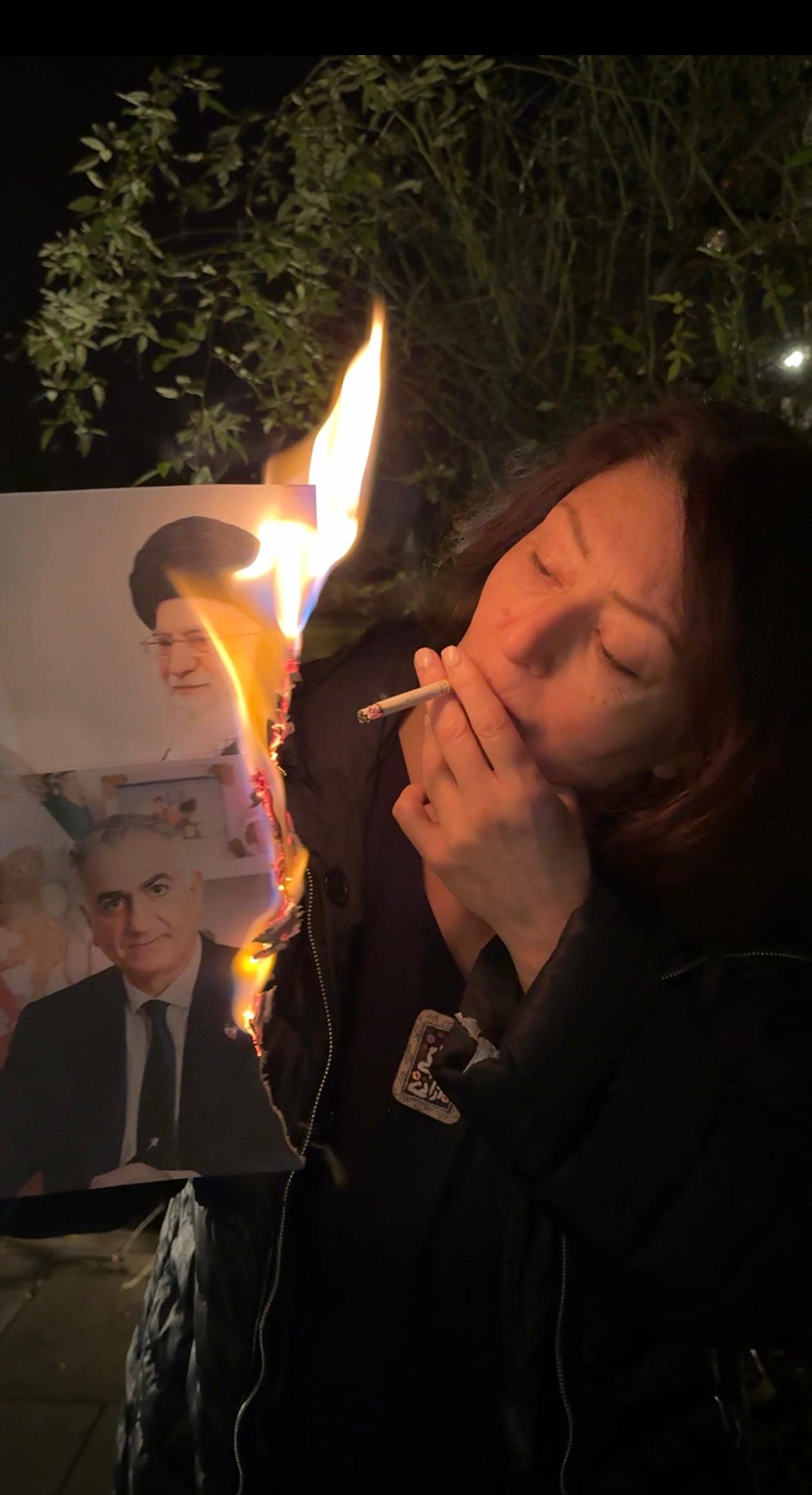
Persian: نه به عمامه و نه به تاج
French: Ni turban ni couronne, mais Femme, Vie, Liberté
Italian: Né turbante, né corona, ma Donna, Vita, Libertà
Greek: Ιράν: Ούτε τουρμπάνι ούτε στέμμα! Ούτε κληρικός ούτε βασιλιάς! Γυναίκα, Ζωή, Ελευθερία
Russian: Ни тюрбана, ни короны – Женщина, жизнь, свобода!
A new nationwide wave of protest has spread across Iran since 28 December 2025. Initially triggered by acute economic collapse (currency freefall, sharp price rises for basic necessities, and renewed scarcity), it has rapidly become a wave of openly anti-regime protests—as has been the case with previous uprisings. Inflation, unemployment, and shortages are products of corruption, security-state monopolies, and repression as governance. The state has responded with its familiar repertoire: lethal force, mass arrests, threats to prosecute detainees as mohareb (‘enemies of God’) and sweeping internet blackouts. The shutdown is not incidental; it is designed to prevent coordination, cover up killings, and isolate people from one another while repression escalates.
A horrifying video circulating online, reportedly taken on 8 January from outside the Kahrizak Forensic Medicine Centre, shows rows of bodies laid out as families search for missing loved ones—and all the while, more bodies arrive by truck.
For over two weeks now, people across Iran have continued to take to the streets to demand an end to the Islamic regime. These protests are a continuation of the 2022 uprising that followed the murder of Mahsa Jina Amini, an uprising that permanently altered Iranian society. Disregard for compulsory hijab, open contempt for clerical authority, and the normalisation of public anti-regime speech were among its lasting gains. But the ‘Jin, Jiyan, Azadi’ or ‘Woman, Life, Freedom’ revolution has unfinished business.
If you follow much of the mainstream and diaspora media, however, you would think that ‘Woman, Life, Freedom’ has been replaced by ‘Long Live the King’ and that material demands for a better society have been replaced with branding and spectacle.
This pattern is chillingly familiar. During the 1979 revolution against the Pahlavi monarchy, slogans such as ‘Independence, Freedom’ were steadily replaced with ‘Independence, Freedom, Islamic Republic’ and chants proclaiming ‘Ruhollah [Khomeini], you are our leader’. Revolutionary memory was rewritten in real time.
Today, some media outlets, like Iran International, have gone so far as to rename the Jina uprising ‘the Iranian National Revolution’, a strategic act of depoliticisation that erases its feminist, class, and revolutionary content. Thus the heir to the Pahlavi dynasty, Reza Pahlavi—a man backed by fascist thugs who attack opponents at protests abroad and defend the Pahlavi regime’s old secret police force—is amplified by the likes of Donald Trump and Benjamin Netanyahu and presented as the alternative.
The move is clear: to shift a revolutionary process rooted in mass struggle toward leader fetishism and the consolidation of power from above. A revolution born of courage and sacrifice is redirected toward a single, pliable figure acceptable to global power blocs and capital.
It feels like 1979 all over again.
At the Guadeloupe Conference that year, leaders of the US, UK, France, and West Germany concluded that the Shah could not be saved. They feared state collapse, leftist influence, and workers’ control of oil and industry and sought an outcome consistent with Cold War strategies that viewed Islamism as a barrier against communism. In that context, Khomeini’s relocation to France and his extensive access to international media helped frame the revolution as a binary choice: Shah or Khomeini.
In 2026, the message is eerily similar: Khamenei or Shah. The aim is to shift legitimacy upward, push aside ‘Woman, Life, Freedom’, and prevent a revolutionary reorganisation of society from below, one that threatens not only clerical rule but repressive social relations and patriarchal authority.
Pahlavi now appears on every major satellite channel and chants of ‘Long Live the Shah’ dominate the protests we are shown. There is mounting evidence that some footage circulating online has been manipulated to amplify this narrative, an illustration of how the manufacturing of consent works to defeat political imagination and possibility. Pahlavi is presented as a saviour to narrow the imaginable future, a future that is firmly female.
In every revolutionary situation, the ruling class attempts to pre-shape outcomes in order to restore ideological control and neutralise the emergence of autonomous and radical organisations and leadership. The women’s ward of Evin Prison is full of such leadership.
Support for Pahlavi as the ‘leader’ serves a precise purpose. It signals inevitability to the women and people of Iran who dared to demand ‘Woman, Life, Freedom’: You wanted liberation, instead you get a dictator’s son. The outcome is already decided. Adjust your expectations.
The speed with which image-making is replacing political struggle with spectacle is astonishing, erasing collective agency and infantilising people as being in need of guidance from a paternal figure imposed from above.
The false binary of Khamenei versus Shah is designed to suffocate revolutionary imagination. This is how revolutions are emptied to make sure that business continues as usual. The revolution opens space through mass courage and struggle; media and elites narrow the options; leadership is imposed; popular forces are co-opted and demobilised.
Reza Pahlavi is not preparation for Iran’s liberation; he is preparation for the revolution’s containment. Revolutions are not defeated solely by bullets and batons; they are also defeated by false narratives and pre-selected futures. The Islamic regime has not even been overthrown, yet the revolution’s core demands are already being postponed.
For those in power, a king whose legitimacy rests on his bloodline and foreign recognition is far safer than ‘Jin, Jiyan, Azadi’, a slogan that originated in the Kurdish feminist struggle and has become a mass rallying cry across Iran to reorganise society around women’s freedom, material improvement, and collective power. Sex apartheid in Iran, including the compulsory hijab, is also an economic policy. It disciplines labour, devalues women’s work, and secures unpaid care and social reproduction under crisis. The call for women’s freedom is, therefore, a call for the liberation of all.
The ‘Khamenei or Pahlavi’ binary does not reflect this reality; it is imposed to prevent revolutionary alternatives from consolidating. Once people accept that there can be only one alternative, the revolution has already been contained. Once leadership is imposed, the repression of women, LGBT people, freethinkers, leftists, and workers can be justified as necessary to ‘protect the transition’. A revolution that hands power to figures engineered from above surrenders its hopes, demands, and future. This is how revolutions are defeated.
What can we do to defend our Woman, Life, Freedom revolution when those in power claim to have already decided its outcome?
One proven defence is to insist on non-negotiable minimum demands: freedom of organisation and the right to strike; release of political prisoners; an immediate abolition of executions and torture; women’s and LGBT rights and equality; laïcité; the abolition of patriarchal and religious laws and institutions; the dismantlement of coercive organs under popular oversight; free expression and conscience; protection of strategic sectors from privatisation; price and rent controls on essentials; wage guarantees; healthcare and social protections. (See, for example, the Woman, Life, Freedom Charter.) These demands require organisation through neighbourhood assemblies, workplace committees, strike coordination, and recallable representatives rooted in struggle.
The classic trap is elections first, women’s rights and social justice later. Without binding guarantees, elections become a means of closing revolutionary openings, not expressing popular will.
The revolution in Rojava, Syrian Kurdistan, offers vital lessons in resisting this trap. Its revolution has been deemed dangerous precisely because it has materially reorganised power around women through autonomous women’s structures, co-leadership, and embedded systems of defence and self-organisation.
In revolutionary moments, women are celebrated as brave bodies in the street; their repression becomes moral fuel. But when it comes to power, authority is always masculinised. The elevation of Reza Pahlavi is not solely due to delusional nostalgia for the monarchy. It is about restoring male authority, neutralising class politics, and suppressing women’s revolutionary autonomy.
History does not repeat itself by accident. It repeats through intervention, the renaming of struggles, the postponement of demands for liberation, and regime changes imposed from above.
‘Woman, Life, Freedom’ is a material challenge to how power is organised in Iran, how labour is disciplined, how social reproduction is enforced, how obedience is secured through patriarchal law and violence. That is precisely why it is being displaced by ‘Man, Nation, Prosperity’ nationalism, by the Shah, by the fantasy of a saviour. The move from programme to personality, from demands to brands, is not neutral. It is a mechanism designed to stop a woman-led revolution.
The historical task before us is not to choose between turban and crown, but to prevent the Jina revolution from being buried under false inevitabilities. This revolution will survive only if its meaning is defended: against kings, against clerics, against sects like the People’s Mojahedin Organisation of Iran, against media-manufactured futures, and against every demand that women and people wait their turn. There is no liberation that comes later. There is no freedom that arrives from above.
Neither turban nor crown!
Neither cleric nor king!
Jin, Jiyan, Azadi!
The article was first published in The Freethinker on 12 January 2026.

Leave a Reply